
Digital Marketing Course With AI 2026: What Should Students Learn?

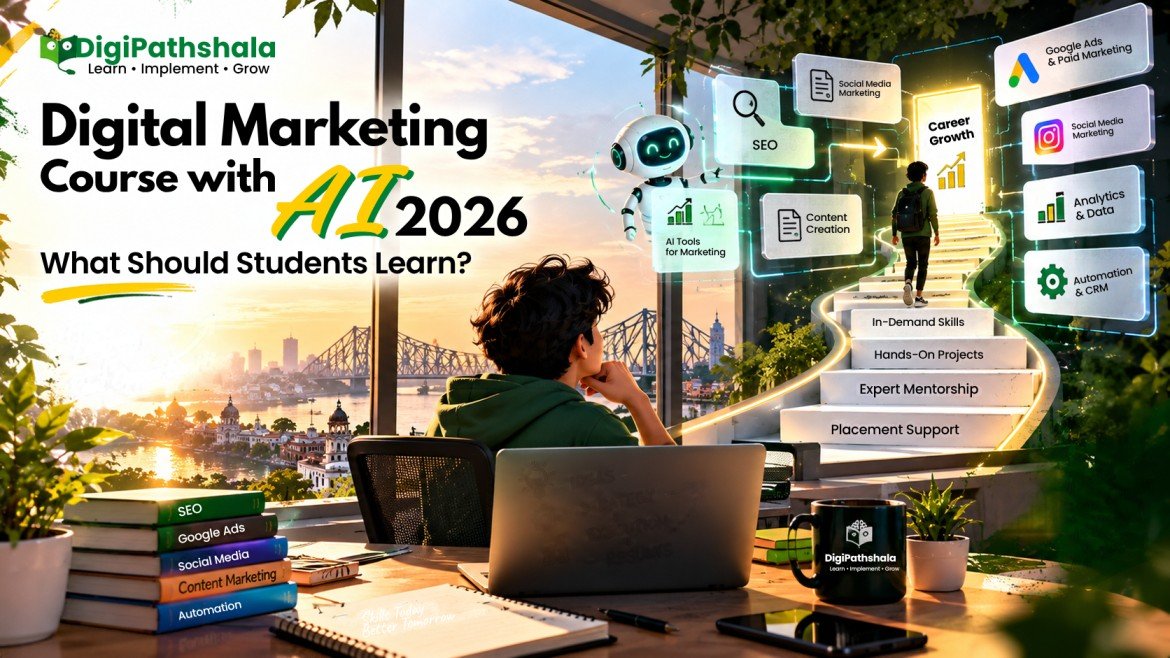
A digital marketing course with AI 2026 can help students develop skills for a rapidly changing marketing industry. AI is now influencing content creation, search, advertising, analytics, and automation.
However, learning AI tools alone is not enough. Students also need strong marketing fundamentals and practical experience.
So, what should students learn in 2026? The answer includes SEO, AEO, content marketing, paid advertising, analytics, automation, AI tools, and strategic thinking.
Why Learn Digital Marketing With AI in 2026?
AI is changing how marketers work. It can help with research, content ideas, data analysis, personalization, and repetitive tasks.
At the same time, search behavior is becoming more conversational. Users can discover information through traditional search and AI-powered experiences.
Therefore, students should learn how to combine marketing knowledge with AI. The goal is not to replace human skills. Instead, AI should help marketers work faster and more effectively.
10 Skills Students Should Learn
1. Digital Marketing Fundamentals
Students should first understand the basics of digital marketing.
These include:
- Target audience research
- Buyer personas
- Marketing funnels
- Customer journeys
- Content strategy
- Campaign objectives
- Conversion goals
- Marketing KPIs
These fundamentals help students understand why a campaign needs to be created before choosing an AI tool.
2. SEO and AI-Powered Search
SEO remains an important digital marketing skill.
Students should learn keyword research, search intent, on-page SEO, technical SEO, off-page SEO, internal linking, and Search Console.
They should also understand how AI can support SEO research and content workflows.
However, marketers must review AI suggestions carefully. Search intent and audience needs should guide the final strategy.
3. AEO and AI Search Visibility
Answer Engine Optimization, or AEO, is another useful skill for modern marketers.
AEO focuses on creating content that directly answers user questions. It also emphasizes clear structure and conversational language.
Students should learn how to:
- Identify question-based searches
- Write direct answers
- Structure useful headings
- Address common user questions
- Build topical relevance
- Create clear, helpful content
AEO can complement SEO across modern search experiences, including Google and AI answer platforms such as Perplexity.
4. AI-Assisted Content Creation
AI can speed up many content tasks. Students can use it for brainstorming, content briefs, social media ideas, email drafts, and content repurposing.
However, human editing remains essential.
Students should add original insights, accurate information, examples, and brand personality. As a result, content becomes more useful and less generic.
5. Prompt Engineering
Prompting is becoming a practical marketing skill.
Students should learn how to give AI clear:
- Context
- Objectives
- Audience information
- Instructions
- Examples
- Output requirements
Good prompts can produce more relevant results. More importantly, students should learn how to build repeatable AI workflows instead of relying on random prompts.
6. Google Ads and Paid Marketing
Students should understand paid advertising fundamentals.
These include campaign objectives, keywords, audience targeting, ad copy, conversion tracking, budgeting, and performance analysis.
AI can support campaign optimization. However, students still need to understand the business goals behind advertising decisions.
7. Social Media Marketing
Social media skills are also important.
Students should learn content planning, copywriting, creative strategy, audience engagement, short-form content, and social analytics.
AI can help generate ideas and content variations. Still, human creativity is important for maintaining a consistent brand voice.
8. Analytics and Data
Marketing decisions require data.
Students should understand website traffic, conversions, engagement, campaign performance, and customer acquisition metrics.
They should also become familiar with tools such as Google Analytics and Google Search Console.
Most importantly, students must learn to turn data into actionable marketing decisions.
9. Marketing Automation
Automation can reduce repetitive marketing work.
Students should learn email workflows, lead nurturing, customer segmentation, CRM basics, and automated follow-ups.
AI can make these workflows more personalized. Therefore, automation is becoming an important part of modern marketing education.
10. Practical AI Marketing Workflows
Finally, students should learn how different skills work together.
A typical workflow could be:
Research → Strategy → Content → Advertising → Analytics → Optimization
AI can support several stages. However, marketers still need to control the strategy and evaluate the results.
Why Practical Projects Matter
Theory alone does not create job-ready skills.
Students should build projects such as:
- SEO audits
- Keyword research
- AI-assisted content campaigns
- Google Ads campaign plans
- Social media campaigns
- Lead-generation funnels
- Analytics reports
- Email automation workflows
These projects can become valuable portfolio pieces.
How to Choose a Digital Marketing Course With AI
Before enrolling, students should check whether the course covers SEO, AEO, AI, paid advertising, social media, analytics, automation, and practical projects.
They should also look for mentorship and opportunities to build a portfolio.
Most importantly, the course should teach students how to use AI responsibly. Learning tools is useful, but learning how to evaluate their output is even more important.
Frequently Asked Questions
What should students learn in a digital marketing course with AI 2026?
Students should learn digital marketing fundamentals, SEO, AEO, AI-assisted content, paid advertising, social media, analytics, automation, and practical campaign execution.
Is AI necessary for digital marketing students in 2026?
AI skills are increasingly valuable. However, students should combine AI knowledge with marketing strategy, creativity, communication, and analytical thinking.
Do students need coding skills for AI-powered digital marketing?
Advanced coding is not required for many digital marketing roles. Basic technical knowledge can still be useful as students develop their careers.
How can students build a digital marketing portfolio?
Students can create SEO audits, content campaigns, advertising plans, social media strategies, analytics reports, and automation projects. They should document the strategy and results for each project.
Conclusion
A digital marketing course with AI 2026 should teach much more than AI tools.
Students need a balanced skill set covering marketing strategy, SEO, AEO, content, advertising, analytics, automation, and AI.
Most importantly, they should gain practical experience.
AI can make marketers faster. Yet human strategy, creativity, critical thinking, and customer understanding remain essential.
Therefore, students who combine these skills can build a stronger foundation for the evolving digital marketing industry.